
Article: Europe Comes to Terms With Market Manipulation; the SEC and the American Media Bury Heads in the Sand

Article - Media, Publications

Europe Comes to Terms With Market Manipulation; the SEC and the American Media Bury Heads in the Sand

Mark Mitchell, DeepCapture,  21 May 2010

Well, the current state of the global financial markets is certainly interesting. I mean, you have to be a bit sick in the head, but if you think about it the right way, it really is “interesting” — sort of like, oo-wee, look, the girl in the cute leotard is falling off the tightrope, there’s no net, and she’s going to go “splat” when she hits that pavement. How interesting! And check it out, the circus animals have gone berserk — the tigers are tearing the trainer into bloody shreds, the elephants are stampeding, the tent might very well collapse, maybe we’re doomed, and look at those clowns – they’re still smiling. How deliciously interesting! Continue reading “Article: Europe Comes to Terms With Market Manipulation; the SEC and the American Media Bury Heads in the Sand”

Article: The Other Blumenthal Scandal

Article - Media, Publications

The Other Blumenthal Scandal

The Wall Street Journal, 21 May 2010

Richard Blumenthal, the Democratic Senatorial candidate from Connecticut, is in trouble this week for lying about having fought in Vietnam. The former Marine reservist admits he “misspoke” on several occasions about his military service and is otherwise unapologetic, but the revelation has thrown open a race that Mr. Blumenthal appeared to have in the bag. Continue reading “Article: The Other Blumenthal Scandal”

Article: Germany bans naked short-selling, swaps speculation

Article - Media, Publications

Germany bans naked short-selling, swaps speculation

China Daily, 19 May 2010

Germany prohibited naked short-selling and speculating on European government bonds with credit-default swaps in an effort to calm the region’s financial markets, sparking investor anxiety about increasing regulation.

The ban, which took effect at the midnight of May 18 and lasts until March 31, 2011, also applies to the shares of 10 banks and insurers, German financial regulator BaFin said in an e-mailed statement. The step was needed because of “exceptional volatility” in euro-area bonds, BaFin said. Continue reading “Article: Germany bans naked short-selling, swaps speculation”

Article: Germany bans naked short-selling

Article - Media

Germany bans naked short-selling

Holder Hansen, Andreas Rinke

Reuters, 18 May 2010

Germany, in an attack on the financial speculation on which it blames much of the euro zone’s debt crisis, on Tuesday announced a ban on some high-risk bets that prices of bonds and stocks will fall.

Analysts, however, were skeptical that Germany’s surprise move to ban some trades in a strategy known as naked short selling could be effective in taming market volatility, with one saying it suggested “desperation.”

Read full article.

Fined: Deutsche Bank Fined by FINRA

Fined

FINRA Fines Deutsche Bank Securities, National Financial Services a Total of $925,000 for Systemic Short Sale Violations

13 May 2010

The Financial Industry Regulatory Authority (FINRA) announced today that it has fined two broker-dealers a total of $925,000 for executing numerous short sale orders in violation of Regulation SHO and for related supervisory violations. FINRA fined New York’s Deutsche Bank Securities $575,000 and Boston’s National Financial Services (NFS) $350,000.

Read full report.

Article: Some lawmakers also shorted stocks, congressional records show

Article - Media

Some lawmakers also shorted stocks, congressional records show

Robert O’Harrow Jr., Dan Keating

The Washington Post, 5 May 2010

As Congress criticized Wall Street for the proliferation of risky derivatives investments and short-selling practices in recent years, some lawmakers privately made highly speculative investments in derivatives funds that sometimes aimed to profit from a decline in the overall performance of the stock market or Treasury bonds, congressional financial disclosure forms show.

Read full article.

Article: Goldman to pay $450,000 over short-selling

Article - Media

Goldman to pay $450,000 over short-selling

March Gordon

Associated Press, 4 May 2010

Goldman Sachs has agreed to pay $450,000 to settle regulators’ allegations that it violated a rule related to short-selling of stocks in 2008-2009, it was announced Tuesday.

The banking company did not admit or deny wrongdoing in paying the civil penalties in agreements with the Securities and Exchange Commission and the New York Stock Exchange’s regulatory arm.

Read full article.

Filing: SEC v Goldman Sachs Execution & Clearing, L.P.

Filing

SEC v Goldman Sachs Execution & Clearing, L.P.

4 May 2010

These proceedings relate to GSEC’s response to the Commission’s September 17, 2008 emergency order enacting temporary Rule 204T to Regulation SHO (“Rule 204T” or the “Rule”). That Rule was an important part of the Commission’s response to concerns about the effects of “naked” short selling upon securities prices.

PDF (8 pages): SEC v Goldman Sachs Execution & Clearing, L.P.

Article: Goldman Sachs settles short-sales allegations

Article - Media, Publications

Goldman Sachs settles short-sales allegations

Associated Press business staff, 04 May 2010

WASHINGTON — Goldman Sachs has agreed to pay $450,000 to settle regulators’ allegations that it violated a rule related to short-selling of stocks in 2008-2009, it was announced Tuesday.

The banking company did not admit or deny wrongdoing in paying the civil penalties in agreements with the Securities and Exchange Commission and the New York Stock Exchange’s regulatory arm.

The case involving Goldman’s stock-trading business is unrelated to the SEC’s civil fraud charges filed against the firm last month over mortgage securities transactions it arranged. Goldman has denied the allegations in that case and said it will contest the charges in court. Continue reading “Article: Goldman Sachs settles short-sales allegations”

Article: In another Wall Street misdeed, Morgan Stanley settles oil-trading flap

Article - Media

In another Wall Street misdeed, Morgan Stanley settles oil-trading flap

Kevin G. Hall

McClatchy Newspapers, 29 April 2010

In another black eye for Wall Street, the Commodity Futures Trading Commission late Thursday announced a $14 million fine against Morgan Stanley Capital Group Inc. for allegedly hiding its complex oil trades.

The settlement, in which Morgan Stanley did not admit or deny the accusations, comes as oil prices have continued their steady upwards march and have some oil analysts again saying that excessive speculation is again pushing up energy prices. One recent estimate put the cost of that to consumers and businesses at $300 billion annually.

Read full article.

Video: CMKM Diamonds Follow Up

Video
Click image to go to video

Alyona follows up with one of our most viewed and asked about stories, CMKM Diamonds. She chats with CMKM shareholder Dave Nelson about the struggles that the shareholders have faced over the past few years.

Article: Wall Street’s Naked Swindle

Article - Media

Wall Street’s Naked Swindle

Matt Taibbi

Rolling Stone, 5 April 2010

On Tuesday, March 11th, 2008, somebody — nobody knows who —made one of the craziest bets Wall Street has ever seen. The mystery figure spent $1.7 million on a series of options, gambling that shares in the venerable investment bank Bear Stearns would lose more than half their value in nine days or less. It was madness — “like buying 1.7 million lottery tickets,” according to one financial analyst.

But what’s even crazier is that the bet paid.

Read full article.

Video: The S.E.Cs 3.87 trillion dollar lawsuit

Video
Click image to go to video

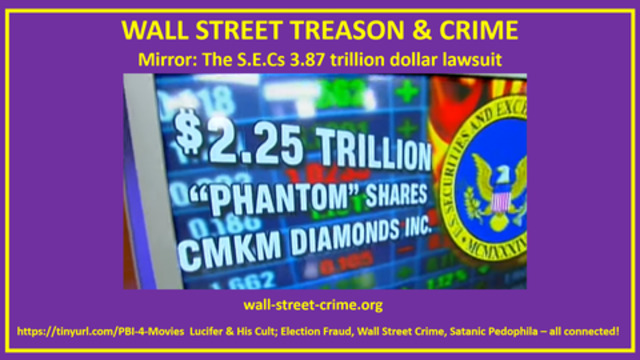
Its the largest fraud case in world history. It is alleged that between June of 2004 and October of 2005, over 2 trillion dollars worth of fake CMKM Diamonds Inc. shares were sold to the public. The companys shareholders are now suing the S.E.C for 3.87 trillion dollars. Tim Barello from the Manhattan Headlines Examiner joins Alyona from New York to tell you more.

Article: Currency wars and the emerging-market countries

Article - Media, Publications

Currency wars and the emerging-market countries

Richard Portes, 04 November 2010

The headlines shout “currency wars”. The US believes China engages in “currency manipulation”. The authorities hesitate to declare this to the US Congress, and the Secretary of the Treasury says “competitive non-appreciation” instead. China accuses the US of excessively loose monetary policy, flooding the world with liquidity. There is some truth in both charges, but some exaggeration.

This is one of the key issues facing the G20. Exchange-rate pressures, global imbalances and rebalancing, spillovers and the desirability of policy coordination – these are at the centre of the economic interdependence between the developed and emerging market countries. All this is in the context of weak US and European recoveries from the Great Recession, the risk of deflation, and the likelihood of more quantitative easing (QE) by major central banks. Domestic issues and inability to get direct action on exchange rates has led the US to propose internationally agreed targets for current-account imbalances. The wheel goes round – these proposals bear some resemblance to those of Keynes at Bretton Woods, which the US then opposed.

Read Full Article